Bhutan Snowman Trek
-
The Snowman Trek is a month long challenging, remote, and high-altitude trek not only in Bhutan or the Himalayas but in the entire world.
The trek route traverses the remote Laya and Lunana regions of Northern Bhutan Himalayas, offering a rare glimpse into both the monumental geography and the ancient cultural traditions of Bhutan.
Well-suited for elite adventurers chasing the ultimate Himalayan endurance test, the Bhutan Snowman Trek route goes through 11 high passes exceeding 4000 m and pristine Bhutanese Himalayas that few ever see.
This epic trek in Bhutan combines the Everest Base Camp’s altitude with the Annapurna Circuit’s remoteness, but in Bhutan’s culturally pristine north, making the Snowman Trek rarer than either of those treks in Nepal.
-
INDIA
Farouttrek
Upper Chiboo Approach Road,
Kalimpong-734301
Darjeeling, West Bengal
Bigfoottreks & Adventures,
Regn.#:10/TD/10/TA
Yuksom Bazaar,
P.O. Gyalshing-Sikkim
NEPAL
Climb High Himalaya,
1st.Floor, Sagarmatha Bazaar,
Mandala Street, Kathmandu-Nepal - CALL US
- INDIA: Mr.Fabian - +91 - 9933975902
- NEPAL: Mr.Dawa - +977-9803001116
- WhatsApp: 9933975902
- info@farouttrek.com
Snowman Trek – A month-long trek in Bhutan for Seasoned Adventurers.
The Snowman Trek in Bhutan is among the most challenging long-duration treks in the world. Often called the holy grail of high-altitude trekking, not because it covers 347 kilometers in 24 days, but the relentless combination of extreme altitude, isolation, rugged terrain, and unpredictable Himalayan weather.
The Snowman trek involves crossing 11 high passes over 4,000 meters, including the formidable Rinchen Zoe La Pass at almost 5,320 meters. Much of the route is in the remote Lunana area near the northern Bhutan- Tibet border, where trekkers are far from roads, towns, and modern facilities.
Starting from the beautiful Paro Valley in eastern Bhutan, the Snowman Trek gradually climbs to the Jhomolhari Base Camp. The trail then meanders deep into the sparsely populated Lunana region, inhabited by yak-herding communities and surrounded by towering mountains and pristine wilderness. The Snowman trek normally concludes at either Nikachu or Sephu in central Bhutan.
For most of the route, there are no teahouses or traditional trekking lodges. Trekkers live in tents and depend on experienced guides, cooks, porters, and pack animals to carry their supplies. The trek is physically demanding because of its remoteness and requires careful preparation, proper acclimatization, and strong mental endurance.
The Snowman Trek also takes you through the most picturesque parts of Northern Bhutan with views of the highest mountains like Jhomolhari, Jichu Drake, Gangkar Puensum, Tiger Mountain, etc.
Snowman Trek Highlights
- Cross a chain of 11 remote Himalayan passes, several of which are above 5,000 meters, including Rinchen Zoe La at approximately 5,326 meters.
- Trek through Laya and Lunana, two of Bhutan’s most isolated highland regions.
- Camp beside glacial lakes, alpine rivers, yak-herder settlements, and high mountain pastures.
- Enjoy spectacular views of Mount Jomolhari, Jichu Drake, Gangchenta (Tiger Mountain), Table Mountain, and numerous unclimbed Himalayan peaks.
- Experience the traditional culture of the Layap and Lunap communities.
- Walk through forests of pine, birch, maple, and rhododendron before entering open alpine tundra and glacial terrain.
- Visit remote settlements such as Laya, Woche, Lhedi, Chozo, and Thanza, depending on the route.
- Look for Himalayan wildlife, including blue sheep, marmots, takin, and high-altitude birds. Snow leopards inhabit the region, but sightings are extremely rare and should never be promised.
- Complete one of the longest and most demanding supported trekking expeditions in the Himalayas.
- Finish with a dramatic crossing of the Lunana wilderness toward Sephu or continue on the longer variation toward Bumthang.
Starting and Ending Points of the Trek
Bhutan Snowman Trek starts from Paro Valley goes further up to Jhomolhari Base Camp, and ends at Nikachu near Trongsa in central Bhutan. The route traverses through Laya Lingzi and the remote Lunana region near the border with Tibet, the most difficult places to reach in the Bhutan Himalaya.
Best Time
The Snowman Trek in Bhutan is best done from mid- or late September to October during the autumn season, or in May during the Spring season. This trek requires top fitness, expedition-grade gear, and a licensed Bhutanese operator (mandatory guide, cook, horsemen).
Difficulty level and fitness requirements for Snowman Trek.
The Snowman Trek in Bhutan is rated as extreme difficulty. One of the world’s toughest treks due to its length, relentless high altitude, technical terrain, and remoteness, requiring a top fitness level, and should possess prior high-altitude trekking experience, and strong mental resilience.
The Snowman Trek is not for beginners—prior multi-week treks like Annapurna Circuit, Three Passes, or Kilimanjaro are essential. High-altitude exposure above 4,500 m is mandatory.
Minimum 12 weeks or more of training with a weighted backpack weighing 10 Kg covering 15–20 km, stair climbing, running, or cycling, strength work, and simulated altitude if possible is necessary to complete the Snowman Trek.
Trekking Permits
The Snowman Trek in Bhutan requires strict permits and a licensed Bhutanese tour operator—independent trekking is prohibited due to its remote, restricted border areas.
Emergency Evacuation for Injury or AMS on the Snowman Trek
Emergency evacuation on the Snowman Trek is difficult because much of the route passes through the roadless valleys of Laya and Lunana. In several sections, reaching the nearest road or health facility may take days. Trekkers should therefore never assume that a helicopter can arrive immediately.
Response to an Injury
For a minor injury, the guide and trekking crew will provide first aid and assess whether the trekker can continue, rest at camp or walk slowly to a lower settlement. A trekker who cannot walk may have to be assisted by the crew or transported by pack animal toward the nearest village, health post, roadhead or suitable helicopter landing area.
Serious trauma may require helicopter evacuation. Bhutan’s current helicopter procedures prioritise life-threatening cases in locations where road evacuation is impossible or would dangerously delay treatment. Activation is decided by Bhutanese health professionals in consultation with emergency specialists.
A helicopter evacuation is not guaranteed. Flights depend on:
- Safe weather and adequate visibility
- Daylight and aircraft availability
- A safe landing or patient-transfer location
- The patient’s condition and medical priority
- Approval and coordination by the relevant authorities
- The aircraft’s operating limits at high altitude
If the helicopter cannot fly immediate assisted descent, pack-animal transport and transfer through a village health facility before reaching an ambulance or roadhead.
Cellular Coverage
Bhutan has two main telecom providers: B-Mobile (Bhutan Telecom) and TashiCell. However, due to the extreme remoteness and high altitude of the Snowman Trek mobile signal is virtually nonexistent.
At the Start & Ending points of the route you will have reliable 4G/LTE coverage in the major towns before and after the trek, such as Paro, Punakha, and Bumthang.
You may get a weak or intermittent mobile signal (primarily B-Mobile) when passing through the highlander village of Laya, but it is highly unreliable and dependent on the weather.
The Lunana Region: Once you enter the ultra-remote Lunana valley (Woche, Lhedi, Thanza, etc.), there is no cellular reception whatsoever.
Power & Charging
Because there is no electrical grid along the trail, most trekking operators carry portable solar panels to charge essential devices (like cameras and phones used for photography).
It is highly recommended to bring at least one or two high-capacity, cold-resistant power banks to keep your personal devices alive. Keep your batteries close to your body or inside your sleeping bag at night, as the sub-zero temperatures will drain them rapidly.
Emergency Communications
Because you cannot rely on a cell phone, safety and communication are handled directly by your trekking agency. Your licensed Bhutanese guiding crew carry a satellite phone or emergency radio. This is strictly reserved for logistics, coordinating with the support team, or arranging helicopter evacuations in the event of severe altitude sickness or extreme weather.
Bhutan Visa
Bhutan’s tourist visa system is built around its unique “High Value, Low Volume” tourism philosophy. The system focuses heavily on a mandatory sustainability levy rather than the visa itself.
The application process and general requirements depend on your nationality:
All International Tourists (except citizens of India, Bangladesh, and the Maldives) must obtain a digital Visa Clearance Letter before boarding their flight to Bhutan.
The cost of entering Bhutan is divided into two parts:
Visa Fee: A one-time, non-refundable processing fee of $40 USD.
Sustainable Development Fee (SDF): This is the daily tourism tax. It is $100 USD per person, per night (this promotional rate is locked in until August 2027). Children aged 6–12 receive a 50% discount ($50 USD/night), and children under 6 are exempt.
How to Apply
Arduous treks like the Snowman Trek legally require a licensed guide and logistical support, your certified Bhutanese tour operator will usually gather your documents, collect the payment, and handle the visa application on your behalf.
Required Documents
-
A passport valid for at least 6 months from your date of departure.
-
A recent digital passport photo against a white background.
-
Mandatory travel insurance that explicitly covers medical emergencies for the duration of your stay.
-
Confirmed arrival/departure flight dates and accommodation details.
- Once approved, you will be emailed a Visa Clearance Letter. You must print this out to show the airline at check-in. The actual physical visa stamp will be placed in your passport upon arrival at Paro International Airport.
Citizens of India, Bangladesh, and the Maldives
-
Indian nationals pay a concessional Sustainable Development Fee of 1,200 INR per person, per night (children aged 6–12 pay 600 INR; under 6 are free).
-
Required Documents: A valid Indian Passport (with minimum 6 months validity) OR a valid Voter Identity Card (EPIC). For children under 18, a birth certificate in English or a passport is required.
-
How to Apply: You can apply online in advance through the Bhutan Department of Immigration or obtain it on arrival at the border pedestrian terminals (like Phuentsholing) or Paro Airport.
TRIP FACTS :
- Style of Trek: Camping
- Trek Grade: Strenuous.
- Duration: 30 Days.
- No. of Days on the Trek: 24 Days.
- Total Distance Covered: 347 Km
- Highest Trekking Altitude: Rinchenzoe Pass (5115 m).
- Highest Sleeping Altitude: Jichu Dramo (4840m)
- Starting Point: Paro
- Ending Point: Nikachu Zam (near Trongsa)
- Minimum No.of Participants: Two Persons.
- Best Season: End of April to May, and Mid or Late September to October.
- Trek Availability: Only Private Treks for a minimum of two pax.
- Customized private Treks can also be arranged for a minimum of two persons on request on a date of your choice.
BHUTAN SNOWMAN TREK ITINERARY
Day 1: Arrive at Paro. Meet your Bhutanese Guide, then drive you to the Hotel.
On a clear day, as you fly into Paro you can witness magnificent views of the world’s highest peaks, from Everest to Mount Kanchenjunga to the Jhomolhari to the lush green Paro valley as you land.
Day 2: Paro – Sight seeing. Overnight Hotel (B,L,D).
After Breakfast drive to the ruins of the Drukgyal Dzong 16 km Built in 1647 by the great Shabdrung Ngawang Namgyal, it was destroyed by fire and left in ruins as an evocative reminder of the great victories it was built to commemorate. Explore the ramparts and on a clear day experience an unforgettable view of Mt. Jumolhari (7,314 m).
Next visit the Ta Dzong, an ancient watchtower, which now houses the National Museum. A short walk takes you to the base of the Dzong and across a traditional cantilevered, covered bridge. Evening free to explore Paro’s market place.
Day 3: Excursion to Taktshang Monastery. Overnight Hotel (B,L,D).
After breakfast take a short drive to Satsam Chorten, from here it’s a 2 hour trek/horse ride till the viewpoint of the monastery. The trail climbs through beautiful pine forest festooned with prayer flags. Stop awhile for a rest and light refreshments at the Taktsang Jakhang (cafeteria) and then trek further to Taktsang monastery.
Built in the 1600s, this incredible monastery clings to the edge of a sheer rock cliff that plunges 900 m into the valley below. Legend has it that Guru Padmasambhava, the tantric
mystic who brought Buddhism to Bhutan, landed here on the back of a flying tiger.
Day 4: Bhutan Snowman Trek Starts. Trek Paro – Shana (2820m/14Km/6Hrs). Overnight Tents.
Drive from Paro Valley toward Shana and begin trekking through farmland, forests and settlements beside the Paro Chhu River. Camp near Shiring Karup at approximately 3,100 metres.
Day 5: Shana-Thangthangka (3610m/21Km/8Hrs). Overnight Tents.
Continue the trek through Jigme Dorji National Park. The trail to Thangthangka climbs gradually through dense forests of pine, oak, birch, maple and rhododendron with few isolated farmhouses on a narrow trekking trail till the campsite.
Day 6: Thangthangka-Jangothang (4240m/15Km/6Hrs). Overnight Tents.
After breakfast the trek starts, passing by a small army post. From here the trail leaves the forest, and gradually ascends into a beautiful valley, passing Tegethang, the winter home of the yak herders, and this also where we stop for lunch will be served. Lots of yaks will be seen today before arriving at the Jhomolhari Base Camp (4,115 m). The campsite offers impressive views of Jomolhari and Jichu Drake, and visible nearby are the ruins of an old fortress used to
guard Bhutan against Tibetan invasions
Day 7: Rest Day at Jangothang.
Spend a full day acclimatising. Optional hikes may lead toward the Jomolhari glacier viewpoint or Tshophu Lake. This rest day is essential, not optional sightseeing. Overnight Tents.
Day 8: Trek Jangothang via the Nyelela pass (4700 m) to Lingshi (4000m/17Km/7Hrs). Overnight Tents.
Cross the first major pass, Nyile La, before descending through rhododendron slopes toward Lingshi village and its historic hilltop dzong
The trek Lingshi offers spectacular views of the Jhomolhari, Jichu Drake and the Tserim Gang. The trek to Nyelela pass (4,700 m) takes 3-4 hours, and starts climbing immediately from our camp site. After reaching the pass the trail descends to Lingshi, where we camp for the night.
Day 9: Trek Lingshi – Chebisa (3780m/12Km/5Hrs). Overnight Tents.
A magical day of trekking on the Snowman Trek, it’s an easy day of trekking. Leaving Lingshi behind the trail gently climbs till Gom Yu, a small mystical village set right below a 300 m cliff. Another hour of easy trekking brings us to Chebisa with a huge waterfall.
Day 10: Trek Chebisa to Shomuthang(3890 m/17Km/7Hrs), and cross the Gokula pass (4320 m). Overnight Tents.
Trek starts immediately with steep climb through high pastures passing through the Gokula
pass (4320 m), after crossing over the pass the trail drops down through forests of dwarf rhododendron for some time. The trail then gently climbs up before heading down to the camp site near a riverbed.
Day 11: Trek Shomuthang over the Jarela pass (4640 m) to Robluthang (4100 m/22Km/8Hrs). Overnight Tents.
A long trekking day over the Jarela pass at 4,640 m offering stunning views of the Himalayan mountains. From here the trail drops down steeply on a thin forest trail to Tsarithang valley, where herds of takin roam. From this valley cross a knee deep river before climbing up to Robluthang where we camp for the night.
Day 12: Trek Robluthang to Lemithang(4040m/7Hrs). Overnight tents.
Today is one of the strenuous trekking days in the Snowman Trek. We climb slowly up to Shinchela pass at 4870 m. and are rewarded with stunning views of the Himalayan mountains, including the spectacular Gang Chen Ta at the head of the valley. On a clear day practically all the mountains on the northern border are visible. Eagles, griffin vultures, blue sheep and yaks abound in this area. We descend down to camp on a lovely spot by the riverbank.
Day 13: Trek Lemithang – Laya (3880m/10Km/5Hrs). Overnight Tents.
The trek to Laya from here follows a small river (one of the tributaries of the Mochu) through rhododendron and silver fir forest before entering village of Laya.
The people of Laya are famous for their vertical stripe yak hair clothing, and their strange conical bamboo hats. The women wear their hair long decorated with turquoise and jade jewellery. The features of the people resemble Tibetan/Mongolian origin, rather than the Bhutanese who live in the central Bhutan.
The rest of the day is spent at leisure, visiting village houses and mixing with the Layap people. The Village of Laya offers good views of the Masagang and the other peaks.
Day 14: Rest day at Laya. Overnight Tents.
Day 15: Trek Laya – Rodophu(4100 m/17Km/7Hrs). Overnight Tents.
The trail from Laya to Rodophu starts with a gentle downhill trek till Tashi Makhang (army camp). From here the trek route starts climbing on a steep trail for an hour, then the trail follows the river until on a level ground untill we reach Rodophu. On a clear day this place offers grand views of the Tsendey Gang mountains.
Day 16: Trek Rodophu to Narithang (4150 m/10Km/5Hrs). Overnight Tents.
From here the climb to the Tsomala pass (4,720 m) is steep and strenuous, but once at the pass hikers are treated to the spectacular view of Gang Chen Ta at the head of the valley. From the pass the trail descend gently, and finally climbs up to Narithang the camp site for the day.
Day 17: Trek from Narithang through the Ganglakarchung La pass(5100m) to Tarina (3900 m/24Km/9Hrs). Overnight tents.
Today’s trek is one of the most strenuous on the Snowman Trek in Bhutan. The trail climbs slowly up to the Ganglakarchung La pass(5,100-m) which takes 3 to 4 hours and are rewarded with stunning views of Ganglakarchung, Tsendey Gang, Jejekangphu and Terigang. Finally we drop steeply down to the Tarina valley where herds of takin roam. Great views of the surrounding
mountains and lakes.
Day 18: Trek Tarina – Woche (3830m/12Km/5Hrs). Overnight Tents.
For the first 4 hours from Tarina the trail follows the river, a tributary of the Pho Chu (river), passing through silver pine and juniper forest, the trail is moderate with a few slight uphill on a narrow trail. The final one hour trek is a steep uphill climb till Woche. From this point the Lunana region of Bhutan begins.
Day 19: Trek Woche trek Lhedi (3640 m/15Km/6Hrs), Over the Keche La pass (4490-m). Overnight Tents.
From Wohe the trail starts climbing gradually through juniper forests for over an hour then drops down to the river bed. The moment you cross a river the other side of the trail offers great views of Jejekangphu, followed by a steep climb past the Yumtso and Setso lakes, and up to the Keche La pass (4,490-m). Once at the pass the trail descends gently to Thraga village and finally to Lhedi.
Day 20: Trek Lhedi – Thanza (4060 m/15 Km/6 Hrs). Overnight Tents.
The trekking trail to Thanza follows the Pho Chu river through the Lhedi village and to Chotsi Dzong, which was built in the 17th century. Eventually after 4 hours of trekking we reach the beautiful village of Dhotey and Thanza where we set camp in a beautiful meadow with stunning views of Table mountain right in front of us.
Day 21: Rest Day in Thanza. Overnight Tents.
Day 22: Trek Thanza to Tshochena (4840 m/24 Km/9 Hrs), and cross over the Jazela pass (5100m). Overnight Tents.
The trek from Thanza to Tshochena is one of the most strenuous day of trekking on the Snowman Trek in Bhutan. After crossing the Pho Chu river there is s very steep 6 hours climb to Jazela pass (5,100 m), before dropping down to Tsochena. After the Pass the trek to Tshochena is a wonderful route decorated by many lakes, and on a clear day can see splendid views of many un-named Himalayan peaks.
Day 23: Trek Tshochena to Jichu Dramo (4840 m/10 Km/5 Hrs) via the Lajula Pass (5000 m). Overnight Tents.
Todays trail is a gradual climb to Lajula pass (5,000 m), and then a downhill trek to reach Jichu Dramo.
Day 24: Trek Jichu Dramo –Rinchenzoe Pass (5115 m) to Chukarpo (4450 m/18 Km/7 Hrs). Overnight Tents.
The climb to Rinchenzoe pass (5115 m) is gradually, and this also the highest pass to traverse on the Snowman Trek in Bhutan. This pass offers spectacular views of Himalayan mountains and turquoise coloured lakes. After the pass its a 5 hour hike to Chukarpo where we set
camp.
Day 25: Trek Churkarpo to Tempetso (4190 m/18 Km/8 Hrs). Overnight Tents.
Today the trail gradually descends to the river, once you reach the river bed it’s a steep climb through rhododendron, silver fir and juniper forests till the Tempetso lake where we set camp.
Day 26: Trek Tempetso to Maorothang (4190 m) via the Tampela pass (4500 m/18 Km/8 Hrs). Overnight Tents.
The trail to Maorothang is besides the lake for about an hour, then it starts climbing up to Tampela pass (4500 m), after the pass it’s a descend to Umtso lake, and to Maorothang where we set camp for the night.
Day 27: Trek Maorothang to Nikachu (2670 m/19 Km/8 Hrs). End of Bhutan Snowman Trek. Overnigh Tents.
Its a gentle trek with a few climbs through dense rhododendron, silver
fir and bamboo forest till Nikachu.
Day 28: Drive Nikachu to Thimphu. Overnight Hotel.
Early morning drive to Thimphu, stop at Wangdue for Lunch Overnight at hotel in Thimphu.
Day 29: Thimpu Sight Seeing. Overnight Hotel.
A day of sight seeing around Thimpu. After breakfast visit the National Library, stocked with ancient manuscripts, and a painting school where traditional art is still kept alive.
Afternoon visit the Dupthop Lakhang, one of the few surviving nunneries in Bhutan. Also visit the Tashichho Dzong the summer residence of the Je Khenpo (Chief Abbot of Bhutan), the National Memorial Chorten built in honour of our late King Jigme Dorji Wangchuk, and the Handicraft Emporium.
Day 29: Drive to Paro Airport for Final Departure. Extension can be made to Sikkim, Darjeeling or Nepal.
—– o0o —–
Snowman Trek Cost (without Air Fare) for a Single Person: US$8900
- ADD: Bhutan Visa Fees: US$ 40
- ADD: GST/Land Tax: US$275
- ADD: Monument Fees: US$ 60
- TOTAL COST FOR A SINGLE PERSON: US$9215 per Person.
- Flights to and from Paro is extra as applicable
—– o0o —–
TREK COST INCLUDES :
- Twin Share Hotel Accommodation in 3 star Hotel with all meals.
- Single Tent per Person with mattress during camping/trekking.
- Fully organized trek services with an experienced English speaking Trekking Guide.
- Cook and Kitchen Helpers.
- Ponies to carry food and equipments, Baggage of hikers, and camping equipments.
- All fixed three meals everyday during trekking/Camping.
- All road transport as per itinerary by private car/jeep.
- Trekking Permit
- Medical first aid kit
- Gamow Bag
- Satellite Phone
- Battery charger
- SDF 2900
COST DOES NOT INCLUDE :
- Bhutan Visa Fees
- Flights to and from Paro
- Airport Tax
- Monument Fees
- Personal clothing/equipment.
- Sleeping Bags
- Bottled or alcoholic drinks.
- Tips, client insurance, evacuation costs.
- Any expenses of personal nature.
Recommendation : The Trek is very strenuous and demands top physical form. A physical fitness check-up is a must. Even the experienced trekker should prepare for 2-3 months prior to the Trek.
Note: The above itinerary is a sample, intended to give you a general idea of the likely trip schedule. Numerous factors such as weather, road conditions, the physical ability of the participants,etc., may dictate itinerary changes either before departure or while on the trail. We reserve the right to change this schedule in the interest of the trip participants’ safety, comfort and general well being.
(All relevant Terms & Conditions apply).
wwwwwwwwwwww
- COST (without Air Fare) for a Single Person: US$8900
- ADD: Bhutan Visa Fees: US$ 40
- ADD: GST/Land Tax: US$ 275
- ADD: Monument Fees: US$ 60
TOTAL COST FOR A SINGLE PERSON: US$9215 per Person.
—– o0o —–
TREK COST INCLUDES :
- Twin Share Hotel Accommodation in 3 star Hotel with all meals.
- Single Tent per Person with mattress during camping/trekking.
- Fully organized trek services with an experienced English speaking Trekking Guide.
- Cook and Kitchen Helpers.
- Ponies to carry food and equipments, Baggage of hikers, and camping equipments.
- All fixed three meals everyday during trekking/Camping.
- All road transport as per itinerary by private car/jeep.
- Trekking Permit
- Medical first aid kit
- Gamow Bag
- Satellite Phone
- Battery charger
- SDF 2900
COST DOES NOT INCLUDE :
- Bhutan Visa Fees
- Flights to and from Paro
- Airport Tax
- Monument Fees
- Personal clothing/equipment.
- Sleeping Bags
- Bottled or alcoholic drinks.
- Tips, client insurance, evacuation costs.
- Any expenses of personal nature.


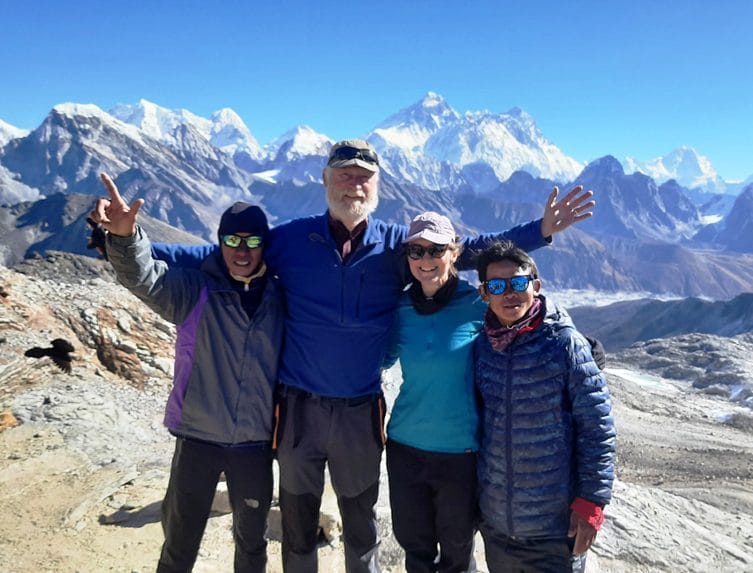

Please Don’t Take Our word for It, Read What Hikers Worldwide Have to Say About Us.